Or, more specifically, 85,591 including:
33,376 Turkey vultures
7 Swallow-tailed kites
1 Mississippi Kite
8 Norther Harriers
29 Sharp-shinned hawks
39 Cooper’s hawks
2 Gray hawks
5109 Broad-winged hawks
41,864 Swainson’s hawks
16 American kestrels
5 Peregrine falcons
5135 Unknown raptors
Details here.
See:
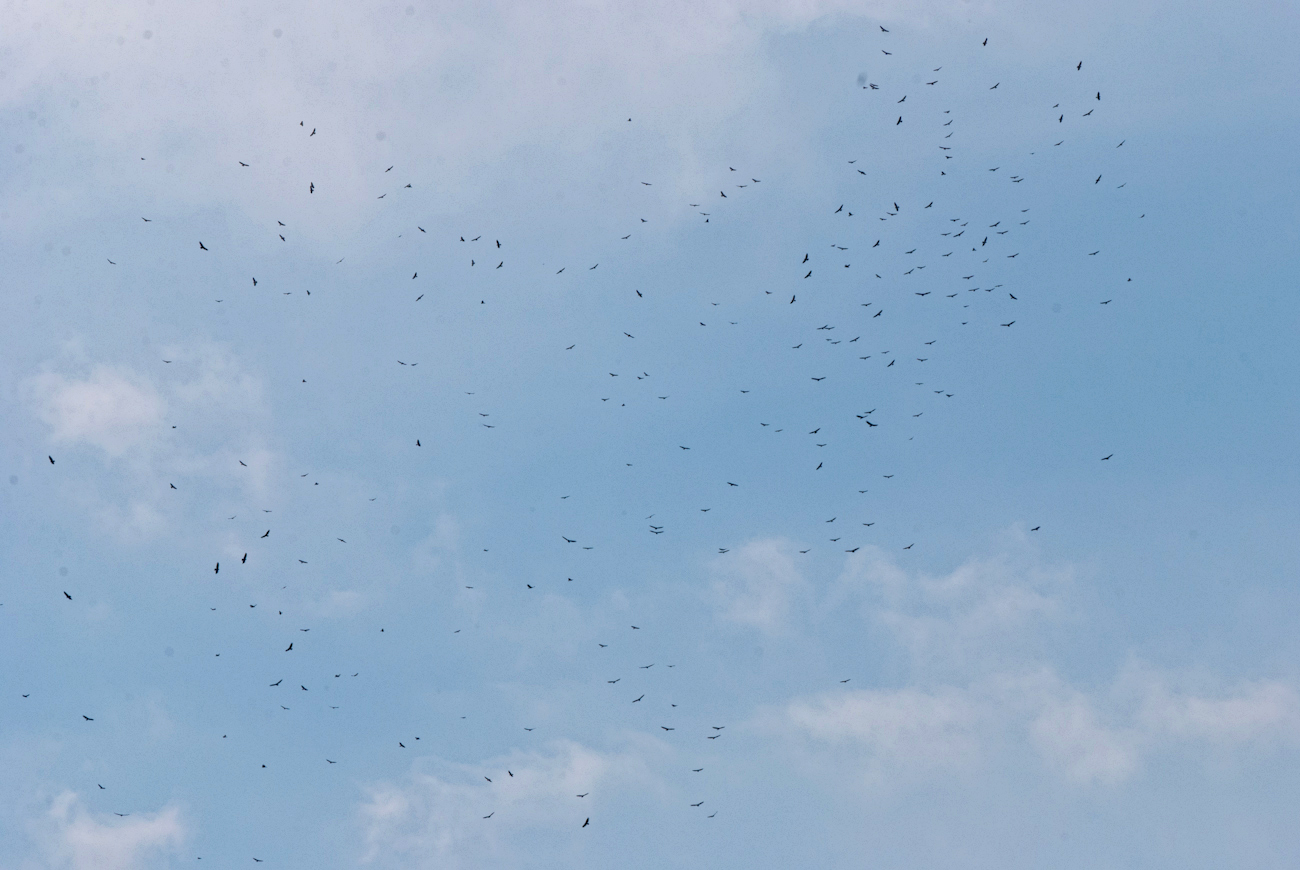
All of this was in just one day observing the RÃo de Rapaces, or River of Raptors, in Cardel and Chichicaxtle, Veracruz, Mexico. This area of Veracruz is under the greatest migration path of raptors in the world. Through September, October, and November of every year, millions of birds fly through this area. I’m not going to paraphrase all the wonderful articles written about this, but instead provide some links to more knowledgeable sources. The Pronatura and other organizations doing the counting and conservation projects down there are doing wonderful work.
http://www.pronaturaveracruz.org/programa_rio_rapaces.php
http://mag.audubon.org/articles/birds/river-raptors
http://www.bioweb.uncc.edu/bierregaard/raptor_river.htm
I tagged along with the Puebla birdwatching club and a couple of other volunteers – the same ones that organized the amazing trip to the Cañón del Sabino to see the military macaws, and the day trip around Malinche. So I always know that I am in for a wonderful experience, and I learn a lot about birds and birdwatching every time. Also, it always worth the bus time, which was not insignificant this time. The state of Veracruz is surprisingly difficult to get to from where I live.
The counters do an impressive job with their clickers. Apparently they are trained with computer simulations and tested before becoming official counters. Sometimes they have 2 clickers in each hand to keep independent counts of 4 different species at the same time. We got to relax and just enjoy the view with cameras, binoculars, and spotting scopes.
The birds use thermals the gain altitude and form a kettle of raptors, or a vortex in Spanish. I like the word vortex to describe the rising, loose tornado-like funnel of raptors. Then individuals will shoot off in the direction of the next thermal. So, the vortexes rise for thousands of feet and are connected by a literal river of raptors. This is up there with the monarchs in terms of the magnificence of the natural world. I’m not going to try to rank these Mexico experiences, but so far the top things, in no particular order are: Monarchs near Valle de Bravo, Military Macaws in Cañón del Sabino, flamingos and other birds in Rio Lagartos, Isla Isabel, and now the Veracruz River of Raptors.
The day did not start well for bird-watching, but the forecast held true and things cleared up around noon. Only a short while after we switched to the more inland observing site at Chichicaxtle did vortexes of birds and the river of raptors appear, and it was worth the wait. Magnificent. The pictures really don’t do it justice because of the distance, but hopefully a few will give you an idea. The birds were rather far, so even at full zoom with the tele lens, the pics of the masses of birds tend to look like nearby swarms of insects. I had to try though. The spotting scope focused on a vortex made the kettle of raptors look like a tilt-shift snow globe of birds swirling and gliding upwards, and only with that amount of magnification would I have any hope of even beginning to guess at the species. The vultures are distinguishable from the hawks by size, shape, and flight style, but I still don’t completely get how they can do the counting. Lots and lots of practice.
I ended up with a lot of what I’ve taken to calling “desktop pics” because they are largely empty space with just a few birds, and therefore perfect for the desktop background image. However, there was a great hummingbird at the end the day, for which the experts are determining the species and I will add it to the image caption when known.
[portfolio_slideshow size=large autoplay=false random=false centered=false carousel=true navstyle=graphical navpos=top pagerstyle=thumbs pagerpos=bottom]
I checked the hummers at BackyardNature, but didn’t find a match. The author, Jim Conrad, is a good friend. He spent many years in Mexico (most recently living in a palapa near Piste, Yucatan). He has a fine collection of photos from Mexico; but he’s presently in west TX. I’ve linked his site below. ~eric.
http://www.backyardnature.net/n/12/120930.htm